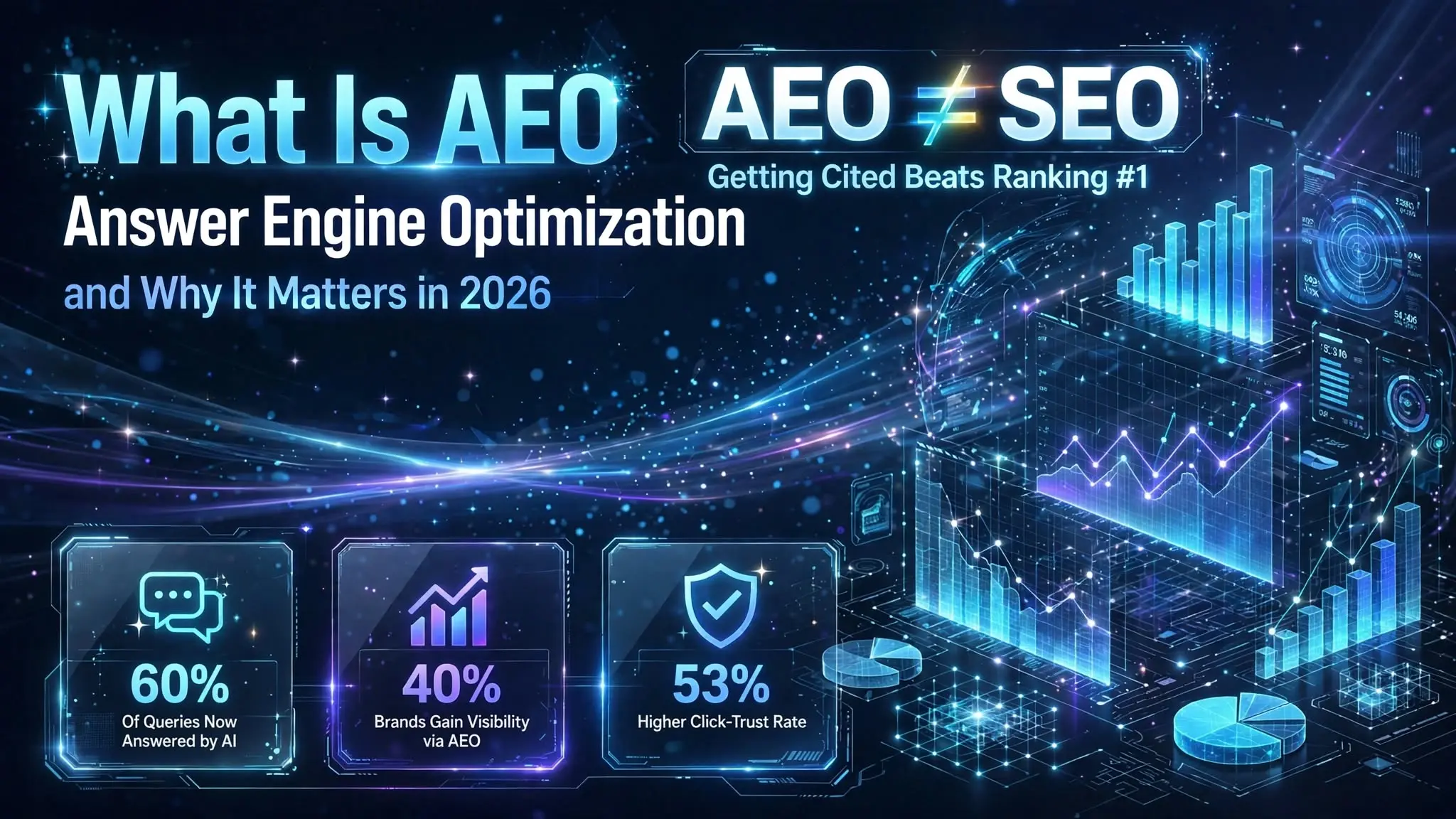
What Is AEO (Answer Engine Optimization) and Why It Matters in 2026
Words: Marks & Methods | Published: September 23, 2026
Words: Marks & Methods | Published: September 23, 2026
AEO. Answer Engine Optimization. It means writing and structuring your content so tools like ChatGPT, Perplexity, Gemini, and Google's AI Overviews can pull it out, understand what it's saying, and quote it directly when they answer someone's question. A lot of the time, that person never clicks through to your site at all. Generative Engine Optimization, or GEO, is the broader academic term for the same discipline, covering optimization across any AI system that generates answers from retrieved content rather than just ranking links.
If that sounds like SEO with a new name, it isn't quite. SEO earns you a ranking. AEO earns you a mention inside someone else's answer. Both matter, and we covered the ranking side in what actually works in SEO in 2026. But the second one is growing fast enough that ignoring it is starting to cost real traffic.
Google's AI Overviews launched a limited rollout in 2024. Independent trackers put AI overviews at somewhere between 6% and 18% of Google searches in early 2025. By early-to-mid 2026, that range had climbed to somewhere between 25% and 50%, depending on the study and which keywords it sampled. Google itself has said the number sits around half of U.S. queries. The exact figure varies by industry and by methodology, but every study points the same direction: up, for two straight years running.
The queries most likely to trigger an AI answer are exactly the ones a service business, an ad agency, a SaaS company, or a local business lives on every day. Pew Research found that question-style searches beginning with "who," "what," "when," or "why" get an AI overview about 60% of the time, and searches of ten words or more trigger one roughly 53% of the time. Short, two-word searches barely register at 8%. The more specific someone's search is, the more likely an AI system answers it directly before your listing ever shows up in the ten blue links underneath.
That has a real cost. The organic click-through rate on queries where an AI overview appears has dropped sharply, with independent studies putting the decline somewhere between 30% and 60% depending on query type and time period. Ranking first still matters. It's just no longer the finish line.
| Traditional SEO | AEO / GEO | |
|---|---|---|
| Goal | Rank on page one | Get cited inside the AI-generated answer |
| Success signal | Position, organic clicks | Citation, brand mention, share of AI voice |
| Content unit | The page | The passage or paragraph |
| What wins | Backlinks, keyword targeting, page authority | Clear structure, cited statistics, extractable answers |
| Where it shows up | Google and Bing search results | ChatGPT, Perplexity, Gemini, Copilot, Google AI Overviews |
| Measured by | Search Console, rank trackers | AI visibility tools (Otterly, Peec AI, ZipTie), manual prompt testing |
The two aren't competitors. Good SEO is still the foundation. Google has said plainly that AI Overviews run on the same core ranking and quality systems as regular Search, and that no special markup is needed to show up in them. But other engines behave differently. ChatGPT, Perplexity, and Copilot pull from a wider range of sources than just the top-ranked page, and they reward content that's structured to be pulled apart into a clean, standalone answer.
Researchers at Princeton studied this directly, testing nine content optimization methods against Perplexity's citation behavior. Citing outside sources in your own content boosted visibility by roughly 40%. Adding statistics with sources added about 37%, and including expert quotations added around 30%. Writing in an authoritative, technical tone was worth about 25%. Keyword stuffing did the opposite of what old SEO habits would predict: it cut visibility by roughly 10%, which trips up a lot of teams still optimizing like it's 2018.
The strongest combination the study found was fluency plus statistics together. Sites that started with weak visibility saw the biggest gains, in some cases over 100%, once they added credible sourcing.
Separately, AI engines lean heavily on third-party mentions over brand-owned content. One 2026 analysis found that a large majority of AI citations trace back to earned media (independent publications writing about a brand) rather than the brand's own blog. Wikipedia, Reddit, YouTube, and industry publications routinely outperform company websites as citation sources, which is why a genuine presence on community and social platforms pays off beyond engagement. That means AEO isn't purely a content-writing exercise. It's partly a digital PR problem, and partly a branding one: getting covered by sources AI engines already trust matters as much as publishing well-structured pages yourself.
AI systems pull passages, not full pages. A page ranking on page three of Google can still get cited in an AI answer if the specific paragraph the AI needs is clean, self-contained, and correctly labeled. In practice, that means answering the question in the first 40 to 60 words of a section instead of building up to it. It means writing headings the way people actually ask a question, not the way an agency likes to describe a service, so "What is AEO?" beats "Our Approach to Discoverability." Comparisons belong in tables, since AI systems parse tabular data more reliably than prose, and a genuine FAQ section with natural-language questions is one of the more directly extractable formats available.
The rest is mostly discipline: cite real numbers with real sources and date them, since undated statistics lose to dated ones once an AI system starts weighing recency. Show a visible "last updated" date on the page itself. Add structured data (article, FAQ page, and how-to schema) where it applies. Google says this isn't required for AI Overviews specifically, but it measurably helps on ChatGPT, Perplexity, and Copilot.
One technical check gets missed constantly: robots.txt. If GPTBot, PerplexityBot, ClaudeBot, or Google-Extended are blocked, that platform cannot cite your content, no matter how well it's written. Check it directly. Don't assume your website's CMS defaults got this right.
Google's own guidance here is unusually direct, and it's worth repeating because a lot of agencies get it backwards. Don't write a separate version of your content "for AI." Don't chop pages into disconnected fragments hoping an algorithm parses them better. Both risk being treated as spam, and neither actually helps, since AI systems are trained to reward genuinely useful, coherent writing rather than content that's obviously been reverse-engineered for a bot. The structural advice above (clear answers, tables, FAQs, and citations) is just good writing organized well. It should read the same to a person and to a machine.
No. AEO builds on SEO rather than replacing it. Strong technical SEO, crawlability, and content quality remain the foundation every AI system draws from. AEO adds a layer of structure and citability on top of that foundation.
Not entirely. Most existing content can be adapted: add a direct-answer opening, a comparison table where relevant, and an FAQ section. New content should be built with extractability in mind from the start. If you're launching a new brand, that's the easiest time to get it right.
Manually run your top 10 to 20 target queries through ChatGPT, Perplexity, and Google, and note whether your brand appears and where. Tools like Otterly AI, Peec AI, and ZipTie automate this tracking across platforms if you want ongoing monitoring rather than a one-time check.
Practically, no. GEO is the term that came out of academic research (notably the Princeton study referenced above) and tends to describe the discipline broadly, across any generative AI system. AEO is the more common industry term, often used interchangeably. Most practitioners today use both terms to mean the same thing.
Marks & Methods is a branding and digital marketing agency in Hyderabad. We build content, websites, and brand presence that search engines rank and AI engines cite. See our work or talk to our team.